Labuche Peak Climbing
Incredible experience in the Eastern Himalayas
Incredible experience in the Eastern Himalayas
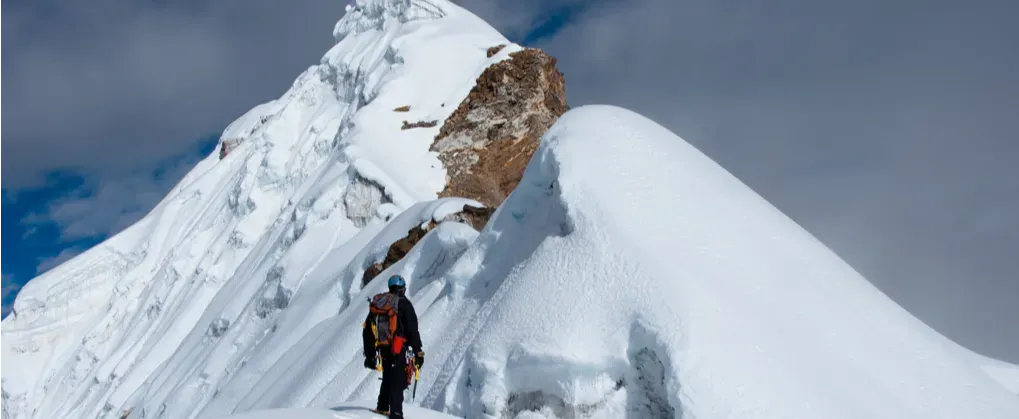
Lobuche Peak climbing is an incredible experience in the Eastern Himalayas. The climb combines with the Everest Base Camp trek making for both an adventurous and spiritual experience.
Lobuche East (6,119 m) stands above the Khumbu region and is an adventurous climb that can be undertaken at relative ease. High atop the peak, you will enjoy the most enticing view of Everest (8848.86 m), Lhotse (8414 m), and Amadablam (6856 m).
The climb offers a chance to immerse oneself in the Sherpa culture in addition to rejoicing in the alpine environment of the Khumbu region. The journey resembles a pilgrimage because Buddhist chants, prayer wheels, flags, and monasteries are scattered along the way.
Tengboche, home to this region's biggest monastery, is a stop on this walk. It was constructed in 1916 and had a sizable statue of Shakyamuni Buddha. The Mani Rimdu Festival, a significant Sherpa holiday, is also observed here.
This journey will take you from lush forests of oak and rhododendron. The region is full of rare and exotic wildlife, such as the peacefully grazing yak, Himalayan Thar, red panda, and even the elusive snow leopard.
Start/Finish
Destination
Grade
Max Altitude
Lukla & Lukla
Nepal
4
6,090 meters
Region
Stay
Group Size
Season
N/A
17 days and 16 Nights
2-12
March-May, September-November
Whether you want to modify a tour package on our website or want an itinerary built from scratch, you can talk with the local travel specalist to create your ideal trip.
In general, the accommodations are in tea houses on a twin basis. Beds usually include a pillow, sheet, and blanket. The services are usually better at lower altitudes, but unlike other treks in Nepal, the EBC trek normally features better provisions. There is a wide variety of food selections, from typical Nepalese Dal Bhat to Chinese and continental dishes. Likewise, you can make choices from the menu as per your interest. Namche and Lukla have a wider selection of restaurants and pubs.
Spring (March to May) and autumn (September to November) are the prime seasons for Lobuche Peak climbing. The other two seasons—winter (December–February) and monsoon (June–August) are less than optimal. While the monsoon season sees tremendous rainfall, winter sees heavy snowfall and fog. Another difficulty might be the provision of flight from Lukla. During these seasons, frequent cancellations and delays of flights can occur.
As far as climbing a Himalayan peak goes for first-timers, Lobuche is at the top of the list. It doesn't require a lot of technical climbing skills, but it will require you to hike 6-7 hours daily, which will be easy if you are physically fit. Hence, before undertaking this trek, you must develop your fitness level with exercises and cardio. There are chances of altitude sickness. Most of the trek will be above 3,500 m elevation, with the highest altitude reaching 6,119 m.
The chances of altitude sickness are ever-present; hence precautions must be taken. We urge you to inform us if you have any persistent medical problem that needs attention. If you regularly take medication, pack extra for the journey. We advise you to maintain a steady pace, drink lots of water, and avoid the use of alcohol and smoke while trekking. There are few medical facilities in the Everest region, so insurance is required. The insurance must cover emergency medical evacuation through helicopter should there be a need.
The duration of the Lobuche Peak climbing expedition can vary, but it typically takes about 2-3 weeks to complete, including acclimatization days.
The highest altitude reached on the Lobuche Peak climbing expedition is the summit of Lobuche Peak at 6,119 meters (20,075 feet).
The best time to do the Lobuche Peak climbing expedition is during the spring (March to May) and autumn (September to November) when the weather is generally stable and clear.
The Lobuche Peak climbing expedition can be challenging, as it involves trekking and climbing at high altitudes. It may not be suitable for beginner climbers, but those with some climbing experience and a good level of fitness should be able to complete it.
Accommodation during the Lobuche Peak climbing expedition is usually in basic lodges or tents. The facilities in the lodges can be quite basic, with shared toilet and washing facilities. Trekkers and climbers should be prepared for a rustic and simple style of living.
Some essential items to pack for the Lobuche Peak climbing expedition include good quality walking boots, warm and waterproof clothing, a sleeping bag, sun protection, a first aid kit, and snacks and water. It's also a good idea to bring climbing gear such as a harness, carabiners, and crampons, as well as a head torch, as there is limited electricity in the remote villages.
The Lobuche Peak climbing expedition is generally considered safe, but as with any climbing expedition in a high altitude environment, it is important to be prepared and take necessary precautions. Climbers should be in good physical condition and properly acclimatized to the high altitude. It is also advisable to hire a reputable climbing company and a local guide, who can provide guidance and assistance if needed.
The food available on the Lobuche Peak climbing expedition is basic and consists mainly of Nepali dishes such as dal bhat (lentils and rice) and momos (dumplings). Vegetarian options are generally available, but it may be more difficult to find other dietary options in the remote villages. Trekkers and climbers should be prepared to eat simple meals and may want to bring some additional snacks.
Electricity can be limited on the Lobuche Peak climbing expedition, and it may not always be possible to charge electronic devices. It is advisable to bring a power bank or portable charger and to use it sparingly. Some lodges may have a generator that can be used for a small fee, but this is not always available. It is best to be prepared for limited access to electricity and to use electronic devices sparingly.
The success rate of the Lobuche Peak climbing expedition can vary depending on a number of factors, including the physical condition and acclimatization of the climbers, the weather conditions, and the route chosen. It is important to be prepared and to follow the guidance of the climbing guides and sherpas in order to maximize your chances of success.

Gokarneshwor-8 , Kathmandu
PO Box: 19908